Thursday, March 10, 2016

Another Batch of Fireforge Medieval Knights

This post originally appeared on the Analogue Hobbies Painting Challenge.

The Analogue Hobbies Painting Challenge is swiftly approaching its deadline, and I'm trying to cram a few more figures in to boost my point total (gotta set a bar to hurdle next year!)

I finished up another set of Fireforge Medieval Knights, this time painted in largely yellow heraldry. Most of these are knights who served in the Scottish Wars, so I've cribbed a few helmets from a set of Teutonic Knights (snipping off some of the more fanciful horns) to represent gear from the latter half of the 13th century.

I selected what I hoped were easier heraldic devices to paint. Little did I realize that "straight lines" are pretty tricky to pull off.

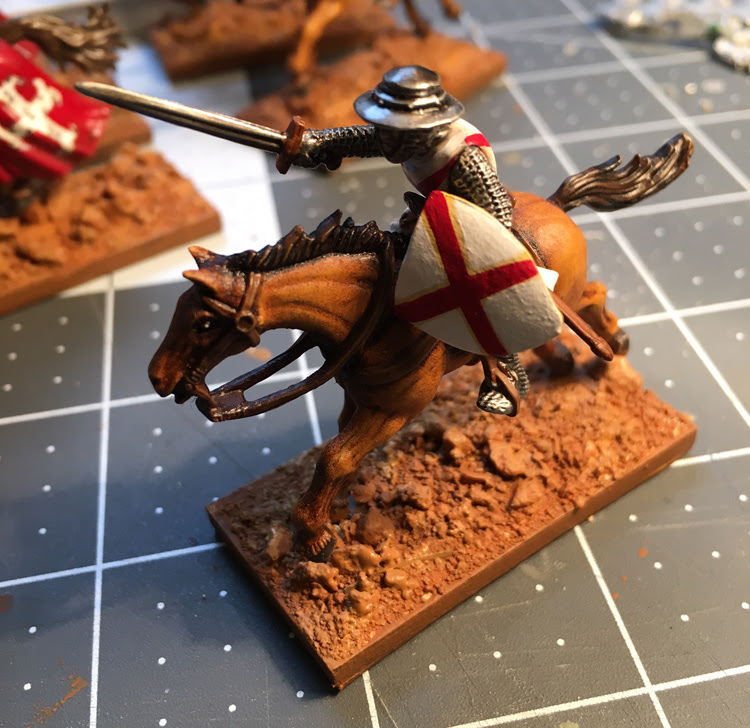
Gilbert de Clare and Thomas de Clare

This is the leader of our merry band, Gilbert de Clare, the Earl of Gloucester. Gilbert de Clare "the Red" (so named for his red hair) fought in the 2nd Baron's War and pledged service to Edward I on crusade. His son (also named Gilbert, and conveniently bearing the same heraldry) also fought in the Scottish Wars. Here he is joined by Thomas de Clare, bearing a banner bearing the de Clare arms.

Piers Mauley and Robert Mauley

Next up is Sir Robert Mauley and Piers Mauley, veterans of the Scottish Wars. Yellow with a black stripe was fairly simple to pull off, but the tiny birds decorating that stripe were pretty fiddly. Props to those who can pull those off!

Robert de Vere and John/William de Vescy


Finally a pair of knights, Robert de Vere and John (or William, they used identical arms) de Vescy. I put off de Vere until last, hesitant to paint the star that adorns his arms. I even tried to find a decal I could borrow from a 15mm WWII Sherman, but without luck. I finally bit the bullet and attempted those daunting stars only to find they were dead simple. Easy! I was worried for nuthin'.

That completes this set of "yellow knights", ready for some skirmish battles.


And also fills out a complete 12 base cavalry unit for mass battles.


That should give me another 60 points. Here's hoping I can squeeze in a few more before the deadline to hit 500!

Saturday, March 5, 2016

Basing Tutorial: How I Base My Wargame Figures

One of the visitors to my blog left a comment asking for an explanation of my basing technique. I don't think I do anything special regarding basing, but I'm happy to oblige in case it helps!

Materials

  • White (PVA) Glue
  • Sand (I picked up a lifetime supply of playground sand from the hardware store. I'm considering sifting out the largest grains or finding a finer grain source)
  • Cheap Paint. I use three shades of Americana craft paint: Raw Sienna, Spicy Mustard and Sand. 


Technique

After gluing the figure to its base and waiting for it to dry, I start by coating the base liberally with white glue.


To level out the difference in height between the figures cast base and the wood base I put a lot of glue around the edge of the cast base and spread a thinner layer around the figure's feet.


While the glue is wet shove it in a box of sand. Shake off the excess.


Check to make sure no extra bits of sand are glued to the figures feet.


Let the glue dry overnight.

Painting

Paint the sand base with Raw Sienna/Medium Brown. The paint helps affix the sand to the base, so coat it thoroughly.


After the base dries, I drybrush with a 50/50 mix of Raw Sienna and Spicy Mustard. For bases depicting arid regions I use more Spicy Mustard, or add a second light drybrush of Spicy Mustard.


I add a final light drybrush of 50/50 Raw Sienna and Sand, just trying to pick out the sharp edges of stones and give the base a general dusting of light color.


I also start working in some of the basing colors into the parts of the figure close to the grown. Here I drybrushed the bottom of the horse covering with the mix of Sand and Raw Sienna to represent dried mud or dust.


Ground Cover

The drybrush coat isn't wet for long, so after I finish painting a batch of bases I quickly move into ground cover. I spread a few lines of white/PVA glue onto the base, and use a toothpick to work it into cracks and crevices. I aim to leave about 50% of the ground untouched by glue (I like the contrast between ground cover and bare earth). For arid regions I'd cover 25% or so.


Next I choose a few Tufts and place them in the biggest patches of glue.


Finally I dab pinches of static grass onto the base.


And that's it! I final coat of matte overcoat and the figure is ready for battle!


Thursday, March 3, 2016

Fireforge Medieval Knights

This post originally appeared on the Analogue Hobbies Painting Challenge.


When I started the Analogue Painting Challenge, I had written off some Fireforge Mounted knights stashed towards the bottom of my lead pile. I vacillated on which heraldry to use and was intimidated by trying to hand paint teeny tiny crosses and birds in 28mm. I figured they'd be too tough to deal with during the speed painting of the competition. After painting up my medieval foot though, I was hooked. I took the "challenge" portion of the painting contest to heart and decided to tackle some medieval knights.

When looking for a period to run Lion Rampant I settled on the reign of Edward I. He was mixed up in internal strife with the 2nd Baron's War, a brief stint on crusade and clashes in Wales and Scotland, providing lots of variety from which to pull scenarios. I collected heraldry from knights in his service, cross referenced them against the number of conflicts they engaged in and picked half a dozen knights and earls who appeared in multiple battles so I could paint a figure once and use it in scenarios throughout the later half of the 13th century.

Then I realized nobody I play against will care, so just got started on painting and didn't sweat the details. So here are my guys!

Antony Bek, Bishop of Durham


First up is Antony Bek, the Bishop of Durham. I know it's pretty common among medieval fantasy games (hence the bludgeoning weapon I gave Tony), but I'm fascinated by the idea of a holy man going to war. Antony served Edward on crusade and in his Scottish wars. I gave Antony an attendant with simple cross heraldry (painting that curley cross with ermine pattern was enough the one time).

Thomas de Berkely and his son Maurice


Next up is Thomas de Berkeley, a grizzled veteran of numerous battles. He fought at Evesham, Falkirk, the siege of Caerlaverock, and Bannockburn. His son Maurice (indicated with the extra blue label on his shield) also served in the Scottish wars, and later served Edward II. Those teeny tiny crosses? Such a pain.

Robert de Neville and retainer


Finally it's Robert de Neville and a member of his retinue. Robert de Neville was involved in the 2nd Baron's War and also has a really simple heraldic device. I love you Robert de Neville.


Six mounted knights completed. Painting (and repainting) the heraldry took longer than expected, but I'm happy with how they turned out and I'm looking forward to finishing up the next six mounted figures from the boxed set. I'm still getting my bearing with the period, so if you have any tips or info to help correct any mistakes (either painting or history) I'd be happy for the advice!


Sunday, February 21, 2016

Oldhammer 40K: "Battle at the Farm" scenario from Rogue Trader


I've been on a nostalgia kick lately, poring over Oldhammer blogs, picking up 20 year old figures from eBay and reacquiring the rulebooks and White Dwarf magazines that were my introduction to the hobby, but have been lost over the last two decades.

I finally got a chance to put some lead on the table and roll some dice and chose to start at the beginning, with the classic "Battle at the Farm" scenario from the original Warhammer 40K: Rogue Trader rule book. Check out our battle down memory lane after the jump.


Tuesday, February 2, 2016

Fireforge Medieval Foot

This post originally appeared on the Analogue Hobbies Painting Challenge.


Medievals have turned out to be the trickiest period I've tried. With World War II there are reams of uniform information to reference for painting. Dark Ages are pretty much "muted earth tones to taste" and information for Ancients is so spotty you can get away with painting them however you'd like, but Medievals... there's just enough heraldry to be confusing and intimidating enough to put me off getting started.

Luckily the Analogue Painting Challenge was just the kick in the rear I needed to throw caution to the wind and paint up these Fireforge Foot with a "good enough for now" paint scheme.

Researching potential paint schemes, I became interested in Edward I. The bad guy from Braveheart was involved in battles from his youth until his death, fighting across the British Isles in the Baron's War and against the Scots, even taking part in the Crusades. His livery was a striking yellow and red, also used by his son Edward II at Bannockburn, and variations on that color scheme appear amongst much of the nobility that fought with or against him. Standardized uniforms were not used during the medieval period, but it's not beyond reason that soldiers would use some sort of identifying color (either a piece of clothing, strip of cloth, or shield color) to identify themselves as belonging to the retinue of a lord.


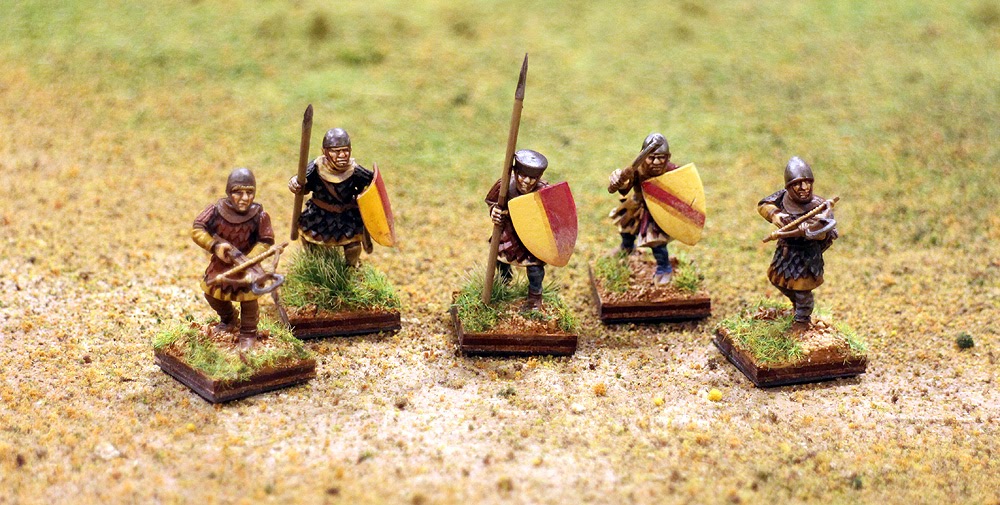
I painted these Fireforge figures up in various earth tones, with a number of red or mustard yellow tunics, surcoats, and leggings. I gave the shields a variety or yellow and red color schemes. I thought there might be some shields provided by a lord, but most would be provided by the men themselves. Without a factory stamping these shields out I tried to vary the color tones and patterns to represent the variety of sources these shields would come from. The Fireforge set also comes with a variety of shields; longer kite shields, and shorter heater shields. From what I gathered, the kite shield is an older design, but lingered on in Eastern Europe, while the heater was far more common from the mid 13th century on. I bought a pack of heater shields from Gripping Beast as I intend to use these figures for the Baron's War and wars against the Scots.


Hopefully the colors will tie the figures together but avoid looking like a uniformed Napoleonic regiment. I'm planning on using these as Edward's household troops, but with such a common color combination I can also use these as the retinue for any knights or nobility with red or yellow heraldry.


I sabot based these for mass battles (such as Hail Caesar), but based them individually so I can try them out with Lion Rampant.

Tuesday, January 5, 2016

The Analogue Hobbies Painting Challenge: "Oldhammer" Space Orks

This post originally appeared on the Analogue Hobbies Painting Challenge.


I was all lined up to crank out some medieval foot when I noticed that the first theme for the Painting Challenge was "nostalgia". I'm a late arrival to historical miniatures, and got my start with Rogue Trader era figures from Games Workshop. I picked up a few of the classic 40K figures to replace those I either lost or never acquired 25 years ago, but until now they've been nestled away in storage drawers. These old sculpts flip all of my nostalgia switches, so I broke out the "Snotling Green" paint and painted them up.


I was initially a bit put off by the sculpts. Most of the rank and file are all hunched up, but after getting some color on them I really dug how full of character these guys are.


I loved all of the little packs, bags, ammo and webbing and the retro, 2000A.D. style sci fi armor their sporting (especially those pineapple shoulder pads). I was really happy to finally give these miniatures some love, attention I'm sure they would have lacked had it not been for the "nostalgia" theme of the Painting Challenge.

Saturday, January 2, 2016

Dungeon Crawl 2015


Each New Year's Eve my friends and I get together to do some 'crawlin', but we've given up on the pubs and switched to dungeons. Check out our subterranean adventures after the jump as the heroes race to defeat the deadly Vampire Lord before the ball drops at midnight!